
How Hackers Discover Open Ports (Port Scanning Explained Simply)
BLOGS
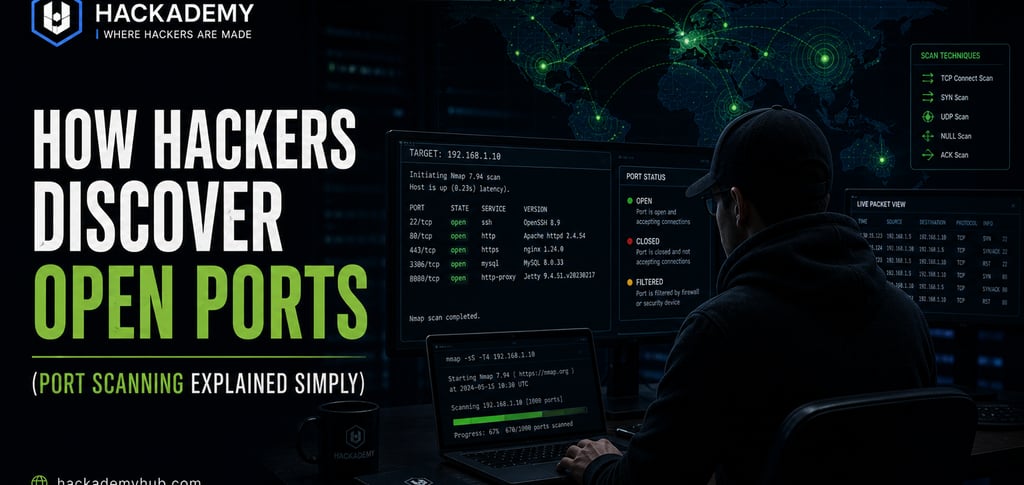

When people hear that hackers “scan systems,” it sounds like something very advanced, but the idea behind it is very straightforward. Before anything serious happens, the first thing is always information gathering. Nobody attacks blindly. The goal is to first understand what is available, what is exposed, and what can be touched.
Think about it like someone standing in front of a building at night. The person is not breaking in immediately. They are checking which doors are open, which windows have lights on, and which entrances look weak. That is exactly what port scanning is doing, just in a digital way.
Every system connected to the internet has ports. Some are open, and some are closed. Open ports mean there is a service running and waiting for communication. Closed ports mean there is nothing listening there. A hacker’s job at this stage is simply to find the open ones.
This is done using tools like scanners. These tools send small connection requests to different ports on a target system. Based on how the system responds, the scanner can tell whether a port is open, closed, or filtered. If a port is open, it means there is something behind it. If it is closed, there is nothing to talk to. If it is filtered, it usually means a firewall is blocking the response.
What makes this powerful is not just finding open ports, but understanding what those ports represent. If port 22 is open, it usually means SSH is running. If port 80 or 443 is open, it means a web server is running. If unusual ports are open, it may mean custom services are running, and those are often the most interesting from an attacker’s point of view.
At this stage, nothing has been attacked yet. This is just observation. But this observation is very important because it shapes everything that comes next. If a system has only one open port, the attack surface is small. If it has many open ports, the attack surface becomes wider.
From a hacker’s perspective, the thinking is simple. Which of these open ports can be used to gain access? Which service looks outdated? Which one is misconfigured? Which one can be tested further?
From a defender’s perspective, this is where discipline matters. If unnecessary ports are open, they should be closed. If services are running, they should be updated and secured. The fewer doors you expose, the harder it becomes for someone to find a way in.
One important thing to understand is that port scanning itself is not always loud. Some scans are very fast and aggressive, while others are slow and quiet. A skilled attacker may scan a system in a way that does not immediately raise suspicion. That is why monitoring and logging are important, because even small patterns can reveal that someone is probing the system.
Understanding port scanning changes how you see systems again. You stop thinking of a server as one solid thing. You start seeing it as a collection of entry points that can be discovered, tested, and potentially exploited.